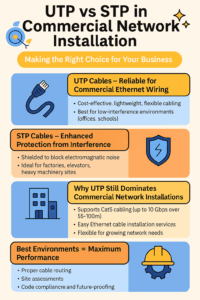
More than 90% of commercial buildings in the U.S. still use copper Ethernet cabling, surprising in an era dominated by wireless technology and fiber optics. When we go further in 2025, the businesses are upgrading their infrastructures, and the decision makers are facing a critical question. Are the good old copper-based solutions, such as unshielded twisted pair (UTP) cables, still in control?
Now, commercial network installation projects require higher bandwidth, reduced interference, and future-ready scalability. Although newer technologies are reshaping connectivity, UTP cables continue to deliver cost-effective, reliable performance in various environments. But when you have shielded alternatives (STP) and enhanced wireless alternatives coming into the market, how do you know which cable solution will be the most suitable for your business?
In this post, we clear up the confusion surrounding UTP vs STP cables. You will learn how UTP still fares, the way it slips, and how coming up to experts for Ethernet cable installation services can guide you to what to do next time your business needs another commercial network installation.
Why UTP Dominates Commercial Network Installation Projects
Unshielded Twisted Pair (UTP) has been the make-or-break in making a commercial network installation modern because of its unparalleled practicality and efficiency. Such a cabling is pairs of insulated copper wires braided together for reduced electromagnetic interference. It plays a vital role in transmitting data signals from small office setups to large enterprise networks.
Key Benefits Driving UTP Adoption
- Delivers Cost-Effective Connectivity: UTP cables are much cheaper than their shielded counterparts, which makes them a perfect fit for wallet-driven commercial installations.
- Simplifies Installation: Their lightweight, flexible design means that cable installation is fast through walls, ceilings, and conduits, with few complications.
- Supports Universal Standards: Most networking hardware is compatible with UTP, which makes this integration flawless and the upgrades easy.
A Brief Look at UTP’s Commercial Rise
- Standardized with Ethernet Growth: During the high adoption of Ethernet in the 80s and 90s, UTP became the default choice. As speeds and bandwidth increased, so too did UTP standards to keep pace with the changing Ethernet standards.
- Adopted Globally Across Industries: Its reliability and low cost have made it the choice for use in offices, schools, hospitals, and the retail environment.
- Backed by Ongoing Innovation: Even nowadays, enhanced UTP types (Cat5e, Cat6, Cat6a, etc.) support modern needs of high-speed data and video transmission.
Choosing the Right Option for Commercial Network Installation: UTP vs STP Cables
When planning an on-site commercial network installation, businesses often face a critical decision: UTP vs STP cables. Each target has distinctive advantages, and an incorrect choice may cause performance problems, higher interference, or needless costs. This guide will usefully rewrite the tangible differences between UTP and STP, allowing you to make the right choice for your network environment.
Shielding and Interference Protection
The first major difference lies in shielding. UTPs (Unshielded Twisted Pairs) have no extra shielding, are lightweight yet cheap, and easy to install. On the other hand, STP (Shielded Twisted Pair) includes a conductive shielding that surrounds each pair (or the whole cable) that is meant to stop electromagnetic interference (EMI).
In quiet/electromagnetic fields, free areas like offices of a small size, the UTP works reliably. However, in high-traveling commercial or industrial atmospheres that are surrounded by electronics and heavy machinery, STP leads the pack. It dynamically protects data signals from adjacent interference, thereby minimizing signal degradation and packet loss.
Noise Resistance and Performance Under Load
UTP vs STP cables, when tested under real-world conditions, show significant differences. UTP cables cope with most general data requirements, such as internet access, VoIP, and simplistic internal networking. But as network demand becomes greater, or cables pass near power lines or industrial gear, then UTP may fail.
Those cables behave better under those circumstances. Its shielding increases noise resistance and guarantees consistent performance in electromagnetically noisy environments. In such environments where uptime and speed don’t compromise data centers, hospitals, and huge corporate campuses comes this stability becomes imperative.
Use Cases: When to Choose UTP or STP
For office environments with low electrical interference, choose UTP. It’s affordable, flexible, and adequate for any daily task.
Consider STP while deploying in the factories, around the elevators, HVAC, or any other industrial site with high EMI issues. In such cases, the added installation costs and complexity are justified by enhanced reliability and performance.
Why UTP Excels in Modern Commercial Network Installation Projects
Unshielded Twisted Pair (UTP) cabling remains one of the most successful commercial network installation options due to its good balance between performance, price, and flexibility. In today’s high-speed networking environments, particularly in office buildings and commercial campuses, UTP still confers solid returns. And this is how it fares in important aspects of concern:
Delivers Competitive Speeds and Bandwidth
UTP cabling provides this ability when used with Cat6 or Cat6a standards by supporting speeds up to 10 Gbps over 55 meters (Cat6) or 100 meters (Cat6a). This performance serves the needs of the majority of contemporary commercial projects, such as video-conferencing, VoIP, and bulky data transfers. Its lower price against shielded options is also a reason this choice is appealing for the needs of budget-conscious projects.
Performs Well in Standard Commercial Environments
The UTP readily works well in most office or retail environments without any form of shielding. Such locations generally possess low levels of electromagnetic interference (EMI), and hence, UTP exhibits great performance without any increased complexity. Installation and maintenance of cabling is also easier, thereby minimizing long-term overhead.
Faces Challenges in Harsh or Industrial Settings
UTP works well in ordinary commercial environments but will have difficulties between rooftops where there is a lot of EMI (electromagnetic interference), such as in manufacturing floors or facilities with heavy machinery. In such cases, shielded cabling (STP or FTP) may provide better signal integrity. Still, though, UTP is pretty practical in clean and climate-controlled commercial spaces.
Supports Scalability for Most Growing Networks
UTP is scalable enough for many businesses as they increase their digital infrastructure. Moving to Cat6a or above enables organizations to deal with higher bandwidth without having to replace the whole cabling design. Such future proofing makes UTP the intelligent long-term option in most commercial network installations.
Maintains Relevance in Urban Installations Like Dallas
In places such as Dallas, Cat6 cabling (UTP today) is the go-to for offices and small campuses. UTP is chosen by network contractors for its cost-effectiveness and ease of installation, particularly in the case of multi-tenant buildings. The growing need for faster connections ensures the continued efficient support of developing demands in Cat6 cabling in Dallas.
Maximize Network Performance with Professional Commercial Network Installation
Professional installation services of professional Ethernet cables are of key importance in creating a dependable and scalable network infrastructure. Businesses rarely consider the impacts of commercial network installation on the long term, but hiring a reliable outfit guarantees that your network facility is installed for efficiency, regulations, and future expansion.
Site Assessment Tailored to Your Business Needs
Commercial network installers start by carrying out thorough assessments of your site. They measure the size, positioning, and network usage plan to establish the best cable paths and placement of hardware. This personalized appraisal prevents signal loss, interference, and bottlenecks the day one.
Strategic Planning and Future-Proofing
These professionals not only install they plan. They develop a network with future scalability in mind, suggesting the appropriate cable types and infrastructure that will be able to accommodate the growth of bandwidth and new technologies. Businesses can escape expensive overhauls if they plan proactively.
Ensuring Code Compliance and Rigorous Testing
Market experts in commercial Ethernet wiring are familiar with local codes and industry standards. They make sure that all installations are safe from the standpoint of electrical safety and fires. Moreover, we run post-installation testing to ensure that your network is functional under load and conforms to the benchmarks.
Expert Guidance on UTP vs. STP Selection
UTP and STP cable choice during cabling depends on your environment. Commercial network installation experts advise you on how best to make the right choice depending on electromagnetic interference level, budget, and performance targets. Through this guidance, you deserve to have optimal data transmission and fewer disruptions.
How We Delivered Reliable Commercial Network Installation with Cat6 Cabling in Dallas
We Assessed the Office’s Network Demands and Layout
We started the commercial network installation by studying the workspace of the Dallas-based client. This enabled us to calculate the best access points, identify high traffic areas, and select the most appropriate cable routing paths. We described the differences between UTP vs STP cables, and this way assisted the client in choosing the most convenient and interference-free cable, depending on his environment.
We Executed Precise Ethernet Cable Installation Services
After the plan, we installed our Ethernet cable installation services using premium Cat6 UTP cables. These cables can transfer quick, high-speed data, i.e, up to 10 Gbps, making them ideal for businesses that use cloud platforms and video conferencing. Our certified technicians provided clean, organized cable routing that was the basis of long-term efficiency in the installation and easier troubleshooting.
We Improved Network Speed and Stability Instantly
After installation, the office realized an immediate increase in the performance of the network. Latency fell by more than 35%, and internal data transfers got smoother. This improvement of commercial Ethernet wiring not only cut down on the down time but also increased productivity across all departments.
We Positioned Ourselves as Dallas’ Local Cabling Experts
With our solutions tailored to them and speedy, accommodating support, we reiterated our status as the preferred team for Cat6 cabling in Dallas. Having knowledge of the local infrastructure codes and best practices provided the client with additional confidence in the long-term success of their network setup.
FAQs About UTP in Commercial Cabling
Is UTP Good Enough for 10 Gbps Networks?
Yes, UTP (Unshielded Twisted Pair) can carry 10 Gbps up to a certain point (the problem here is the cabling). If you have high-quality cabling like Cat6 cabling in Dallas, you should be fine for such speeds. Cat6a is particularly best for 10 Gbps over longer distances, so ideal for many commercial environments. UTP works reliably in high-speed networks when it is provided by professionals engaged in Ethernet cable installation. It is a cost-saving approach for businesses that need fast and efficient data transfer.
How does UTP Handle Interference?
UTP reduces interference by its twisted pair design that cancels the electromagnetic interference (EMI). Nonetheless, in the high-EMI environment, there is a meaningful comparison of UTP STP cables. UTP is adequate for most commercial configurations, however, STP (Shielded Twisted Pair) gives an extra layer of protection. Given that, skillful technicians installing commercial networks maintain optimal routing and spacing to minimize interference from the UTP cables.
Is it Cheaper to Install UTP than STP?
Indeed, the UTP is usually less expensive to buy and to install than the STP. It does not need grounding, special shielding, or more labour, which cuts the overall cost of a project. When businesses are seeking commercial Ethernet wiring, they usually go for UTP because it marries affordability with performance. Professional Ethernet cable installation services amount to a better, budget-friendly solution.
Does Building Size or Layout Affect Which Cable to Use?
Indeed, the physical layout and size of a building play a major role in cable choice. In big buildings or those structured in a complicated manner, signal attenuation and interference risk increase. Professionals in commercial network installation evaluate these considerations and may suggest Cat6 in Dallas for longer runs or high bandwidth requirements. Another way to decide between choosing UTP vs STP cables also depends on the environment; STPs may be used in areas that have high electronic interference.
Conclusion
Unshielded Twisted Pair (UTP) cables continue to provide reliable performance for many business networks, particularly in benign interference environments. But as your bandwidth needs outgrow and your infrastructure requirements expand, UTP may no longer be the best choice. When it comes to UTP vs STP cables, for businesses, the right choice can change everything from network speed to long-term scalability.
That’s where we come in. Our commercial network installation specialists work to understand your specific environment and provide customized solutions accordingly. Whether it’s upgrading for Cat6 cabling in Dallas or a need for commercial Ethernet wiring, or top-of-the-line Ethernet cable installation services, we are ready to help you make the smartest investment in your network.
Let’s future-proof your infrastructure. Book a professional site survey, download our free cabling guide, or contact us today for a free, fast quote with no obligation. No matter what you need in a network, we’ll wire you to succeed.
Ethernet Port Light Colors Explained for Smooth Business Wiring
Harrison Thornburg
Project Manager — Cabling in DFW (an Ighty Support Company)
More than 90% of commercial buildings in the U.S. still use copper Ethernet cabling, surprising in an era dominated by wireless technology and fiber optics. When we go further in 2025, the businesses are upgrading their infrastructures, and the decision makers are facing a critical question. Are the good old copper-based solutions, such as unshielded twisted pair (UTP) cables, still in control?
Now, commercial network installation projects require higher bandwidth, reduced interference, and future-ready scalability. Although newer technologies are reshaping connectivity, UTP cables continue to deliver cost-effective, reliable performance in various environments. But when you have shielded alternatives (STP) and enhanced wireless alternatives coming into the market, how do you know which cable solution will be the most suitable for your business?
In this post, we clear up the confusion surrounding UTP vs STP cables. You will learn how UTP still fares, the way it slips, and how coming up to experts for Ethernet cable installation services can guide you to what to do next time your business needs another commercial network installation.
Table of Contents
Why UTP Dominates Commercial Network Installation Projects
Unshielded Twisted Pair (UTP) has been the make-or-break in making a commercial network installation modern because of its unparalleled practicality and efficiency. Such a cabling is pairs of insulated copper wires braided together for reduced electromagnetic interference. It plays a vital role in transmitting data signals from small office setups to large enterprise networks.
Key Benefits Driving UTP Adoption
A Brief Look at UTP’s Commercial Rise
Choosing the Right Option for Commercial Network Installation: UTP vs STP Cables
When planning an on-site commercial network installation, businesses often face a critical decision: UTP vs STP cables. Each target has distinctive advantages, and an incorrect choice may cause performance problems, higher interference, or needless costs. This guide will usefully rewrite the tangible differences between UTP and STP, allowing you to make the right choice for your network environment.
Shielding and Interference Protection
The first major difference lies in shielding. UTPs (Unshielded Twisted Pairs) have no extra shielding, are lightweight yet cheap, and easy to install. On the other hand, STP (Shielded Twisted Pair) includes a conductive shielding that surrounds each pair (or the whole cable) that is meant to stop electromagnetic interference (EMI).
In quiet/electromagnetic fields, free areas like offices of a small size, the UTP works reliably. However, in high-traveling commercial or industrial atmospheres that are surrounded by electronics and heavy machinery, STP leads the pack. It dynamically protects data signals from adjacent interference, thereby minimizing signal degradation and packet loss.
Noise Resistance and Performance Under Load
UTP vs STP cables, when tested under real-world conditions, show significant differences. UTP cables cope with most general data requirements, such as internet access, VoIP, and simplistic internal networking. But as network demand becomes greater, or cables pass near power lines or industrial gear, then UTP may fail.
Those cables behave better under those circumstances. Its shielding increases noise resistance and guarantees consistent performance in electromagnetically noisy environments. In such environments where uptime and speed don’t compromise data centers, hospitals, and huge corporate campuses comes this stability becomes imperative.
Use Cases: When to Choose UTP or STP
For office environments with low electrical interference, choose UTP. It’s affordable, flexible, and adequate for any daily task.
Consider STP while deploying in the factories, around the elevators, HVAC, or any other industrial site with high EMI issues. In such cases, the added installation costs and complexity are justified by enhanced reliability and performance.
Why UTP Excels in Modern Commercial Network Installation Projects
Unshielded Twisted Pair (UTP) cabling remains one of the most successful commercial network installation options due to its good balance between performance, price, and flexibility. In today’s high-speed networking environments, particularly in office buildings and commercial campuses, UTP still confers solid returns. And this is how it fares in important aspects of concern:
Delivers Competitive Speeds and Bandwidth
UTP cabling provides this ability when used with Cat6 or Cat6a standards by supporting speeds up to 10 Gbps over 55 meters (Cat6) or 100 meters (Cat6a). This performance serves the needs of the majority of contemporary commercial projects, such as video-conferencing, VoIP, and bulky data transfers. Its lower price against shielded options is also a reason this choice is appealing for the needs of budget-conscious projects.
Performs Well in Standard Commercial Environments
The UTP readily works well in most office or retail environments without any form of shielding. Such locations generally possess low levels of electromagnetic interference (EMI), and hence, UTP exhibits great performance without any increased complexity. Installation and maintenance of cabling is also easier, thereby minimizing long-term overhead.
Faces Challenges in Harsh or Industrial Settings
UTP works well in ordinary commercial environments but will have difficulties between rooftops where there is a lot of EMI (electromagnetic interference), such as in manufacturing floors or facilities with heavy machinery. In such cases, shielded cabling (STP or FTP) may provide better signal integrity. Still, though, UTP is pretty practical in clean and climate-controlled commercial spaces.
Supports Scalability for Most Growing Networks
UTP is scalable enough for many businesses as they increase their digital infrastructure. Moving to Cat6a or above enables organizations to deal with higher bandwidth without having to replace the whole cabling design. Such future proofing makes UTP the intelligent long-term option in most commercial network installations.
Maintains Relevance in Urban Installations Like Dallas
In places such as Dallas, Cat6 cabling (UTP today) is the go-to for offices and small campuses. UTP is chosen by network contractors for its cost-effectiveness and ease of installation, particularly in the case of multi-tenant buildings. The growing need for faster connections ensures the continued efficient support of developing demands in Cat6 cabling in Dallas.
Maximize Network Performance with Professional Commercial Network Installation
Professional installation services of professional Ethernet cables are of key importance in creating a dependable and scalable network infrastructure. Businesses rarely consider the impacts of commercial network installation on the long term, but hiring a reliable outfit guarantees that your network facility is installed for efficiency, regulations, and future expansion.
Site Assessment Tailored to Your Business Needs
Commercial network installers start by carrying out thorough assessments of your site. They measure the size, positioning, and network usage plan to establish the best cable paths and placement of hardware. This personalized appraisal prevents signal loss, interference, and bottlenecks the day one.
Strategic Planning and Future-Proofing
These professionals not only install they plan. They develop a network with future scalability in mind, suggesting the appropriate cable types and infrastructure that will be able to accommodate the growth of bandwidth and new technologies. Businesses can escape expensive overhauls if they plan proactively.
Ensuring Code Compliance and Rigorous Testing
Market experts in commercial Ethernet wiring are familiar with local codes and industry standards. They make sure that all installations are safe from the standpoint of electrical safety and fires. Moreover, we run post-installation testing to ensure that your network is functional under load and conforms to the benchmarks.
Expert Guidance on UTP vs. STP Selection
UTP and STP cable choice during cabling depends on your environment. Commercial network installation experts advise you on how best to make the right choice depending on electromagnetic interference level, budget, and performance targets. Through this guidance, you deserve to have optimal data transmission and fewer disruptions.
How We Delivered Reliable Commercial Network Installation with Cat6 Cabling in Dallas
We Assessed the Office’s Network Demands and Layout
We started the commercial network installation by studying the workspace of the Dallas-based client. This enabled us to calculate the best access points, identify high traffic areas, and select the most appropriate cable routing paths. We described the differences between UTP vs STP cables, and this way assisted the client in choosing the most convenient and interference-free cable, depending on his environment.
We Executed Precise Ethernet Cable Installation Services
After the plan, we installed our Ethernet cable installation services using premium Cat6 UTP cables. These cables can transfer quick, high-speed data, i.e, up to 10 Gbps, making them ideal for businesses that use cloud platforms and video conferencing. Our certified technicians provided clean, organized cable routing that was the basis of long-term efficiency in the installation and easier troubleshooting.
We Improved Network Speed and Stability Instantly
After installation, the office realized an immediate increase in the performance of the network. Latency fell by more than 35%, and internal data transfers got smoother. This improvement of commercial Ethernet wiring not only cut down on the down time but also increased productivity across all departments.
We Positioned Ourselves as Dallas’ Local Cabling Experts
With our solutions tailored to them and speedy, accommodating support, we reiterated our status as the preferred team for Cat6 cabling in Dallas. Having knowledge of the local infrastructure codes and best practices provided the client with additional confidence in the long-term success of their network setup.
FAQs About UTP in Commercial Cabling
Is UTP Good Enough for 10 Gbps Networks?
Yes, UTP (Unshielded Twisted Pair) can carry 10 Gbps up to a certain point (the problem here is the cabling). If you have high-quality cabling like Cat6 cabling in Dallas, you should be fine for such speeds. Cat6a is particularly best for 10 Gbps over longer distances, so ideal for many commercial environments. UTP works reliably in high-speed networks when it is provided by professionals engaged in Ethernet cable installation. It is a cost-saving approach for businesses that need fast and efficient data transfer.
How does UTP Handle Interference?
UTP reduces interference by its twisted pair design that cancels the electromagnetic interference (EMI). Nonetheless, in the high-EMI environment, there is a meaningful comparison of UTP STP cables. UTP is adequate for most commercial configurations, however, STP (Shielded Twisted Pair) gives an extra layer of protection. Given that, skillful technicians installing commercial networks maintain optimal routing and spacing to minimize interference from the UTP cables.
Is it Cheaper to Install UTP than STP?
Indeed, the UTP is usually less expensive to buy and to install than the STP. It does not need grounding, special shielding, or more labour, which cuts the overall cost of a project. When businesses are seeking commercial Ethernet wiring, they usually go for UTP because it marries affordability with performance. Professional Ethernet cable installation services amount to a better, budget-friendly solution.
Does Building Size or Layout Affect Which Cable to Use?
Indeed, the physical layout and size of a building play a major role in cable choice. In big buildings or those structured in a complicated manner, signal attenuation and interference risk increase. Professionals in commercial network installation evaluate these considerations and may suggest Cat6 in Dallas for longer runs or high bandwidth requirements. Another way to decide between choosing UTP vs STP cables also depends on the environment; STPs may be used in areas that have high electronic interference.
Conclusion
Unshielded Twisted Pair (UTP) cables continue to provide reliable performance for many business networks, particularly in benign interference environments. But as your bandwidth needs outgrow and your infrastructure requirements expand, UTP may no longer be the best choice. When it comes to UTP vs STP cables, for businesses, the right choice can change everything from network speed to long-term scalability.
That’s where we come in. Our commercial network installation specialists work to understand your specific environment and provide customized solutions accordingly. Whether it’s upgrading for Cat6 cabling in Dallas or a need for commercial Ethernet wiring, or top-of-the-line Ethernet cable installation services, we are ready to help you make the smartest investment in your network.
Let’s future-proof your infrastructure. Book a professional site survey, download our free cabling guide, or contact us today for a free, fast quote with no obligation. No matter what you need in a network, we’ll wire you to succeed.
CORPORATE OFFICE
1509 W Hebron Parkway
Suite Number 150
Carrollton, TX 75010
Contact Us
Search Here
Most Recent Posts
Category
Request A CallBack
Our mission is to provide reliable, future-ready cabling solutions that support business success while maintaining the highest standards of quality and safety.
Useful Links
Our Services
Contact Us
1509 W Hebron Parkway, Suite Number 150, Carrollton, TX 75010
(469) 478-2121
info@cablingindfw.com
Copyright © 2026 Cabling in DFW | All Rights Reserved | Designed and Maintained by DFW Website SEO