You have two or three cabling proposals on your desk. They all claim to cover the same office. The totals are different, and the line items do not match. That gap between quotes is where most businesses either overpay or get stuck with incomplete work. This guide breaks down what a commercial structured cabling quote should include, what common exclusions look like, and how to compare proposals before you approve anything. Everything here applies to offices, warehouses, medical facilities, and other commercial buildings across Dallas-Fort Worth (DFW).
Need an itemized cabling quote for your DFW project? Cabling in DFW offers free site visits across Dallas-Fort Worth. Request a free site visit.
Why the Quote Matters More Than the Price
A low number on the bottom line feels good until the invoice arrives with add-ons that were never in the original scope. We see this in Dallas and Fort Worth offices regularly. The contractor quoted 48 network drops but left out pathway work, testing, or documentation. The business owner assumed those items were included because the proposal said “structured cabling installation.” They were not.
Commercial cabling installation cost factors go well beyond cable and labor. Pathway conditions, ceiling types, building access rules, and telecom room readiness all change what the project actually costs. A quote that ignores those variables is not cheaper. It is incomplete. The only way to compare proposals fairly is to know what each line item means and whether anything important is missing.
What Should a Cabling Quote Include? The Line-Item Checklist
Every commercial structured cabling proposal should itemize these categories. If a quote bundles everything into one lump sum with no breakdown, ask for the detail. Here is what to look for.
Connection Quantities and Locations
The quote should list the total number of network drops and where each one goes. That means a count per room, per floor, or per zone, depending on the building layout. A Plano office with 60 workstations needs a different drop plan than an Irving warehouse with 15 access points spread across 40,000 square feet. If the quote just says “install data drops” without a number, the scope is not defined.
Cable Type and Category

The proposal should name the cable: Cat6, Cat6A, or fiber. Cat6 handles 1Gbps at 100 meters and works for most standard office setups. Cat6A supports 10Gbps at the same distance and is the better pick for buildings running PoE++ devices, dense Wi-Fi access points, or high-bandwidth applications. Fiber optic runs are usually specified for backbone connections between floors or buildings, and for long horizontal distances that exceed copper limits.
If the quote does not name the cable category, you cannot compare it to another bid. A quote listing “Cat6” and a quote listing “Cat6A” are not the same job, even if the drop count matches. Structured cabling installers in DFW should specify the cable type, manufacturer or grade, and whether the cable is plenum-rated or riser-rated based on where it runs.
Pathway and Infrastructure Details
Cable does not run through air. It runs through conduit, cable trays, J-hooks, or existing ceiling pathways. The quote should describe the pathway method and note any new infrastructure required. This is one of the biggest cost variables on commercial jobs. A Carrollton office with a drop ceiling and open plenum space above is a different install than a downtown Dallas building with concrete ceilings and sealed walls.
If pathway work is not in the quote, ask whether it is included or excluded. Some contractors assume the customer handles wall penetrations, core drilling, or conduit runs separately. That assumption can add thousands to the final cost. If the scope includes new drops or pathway work, review what is covered under data cabling installation services before comparing bids.
Testing Standards
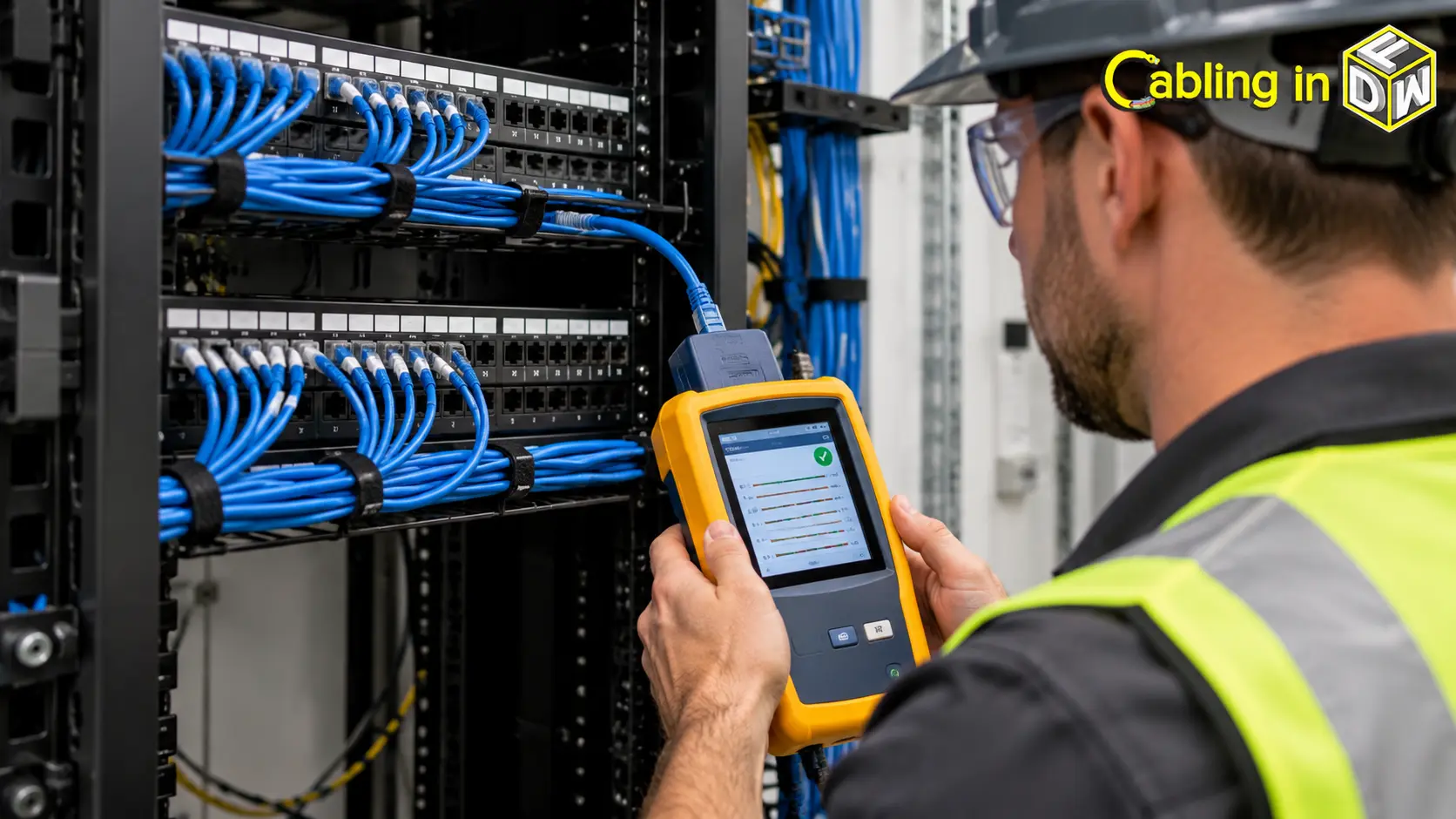
Every installed cable should be tested with a channel-level or permanent-link tester, not a basic continuity checker. The quote should reference the test standard, typically TIA-568 for structured cabling. Fluke or equivalent certification-level testing confirms that each run meets the rated performance for its cable category. If a proposal says “all cables tested” without naming the standard or the test equipment, ask what that actually means.
Test results should be delivered as a formal report, not a verbal confirmation. This report becomes part of your as-built documentation and matters for warranty claims, future troubleshooting, and contractor accountability.
Labeling Scheme
Both ends of every cable should be labeled so your IT team or your next contractor can identify any run without tracing it by hand. The quote should describe the labeling format: numbered, alpha-numeric, color-coded, or matched to a patch panel schedule. Labeling sounds minor until you have 200 cables landing in a telecom room and no way to tell which one goes to which office.
Rack, Patch Panel, and Hardware
If the project includes a new rack, patch panel, or cable management hardware, those items should be listed with quantities and specifications. A two-post relay rack is not the same as an enclosed four-post cabinet with cable management. If the quote includes a patch panel, it should say how many ports and what category.
If the quote assumes the customer supplies hardware, that needs to be stated. Otherwise the business owner may expect the contractor to provide everything and discover at install time that the rack is not included.
Handover Deliverables
Ask what you get when the job is done. A professional install includes test reports, a labeling schedule, a patch panel map, and as-built documentation showing cable routes and termination points. These documents are how your IT team supports the network after the contractor leaves. If the quote does not list handover deliverables, the contractor may not plan to provide them.
Comparing quotes for a DFW office or commercial building? Cabling in DFW provides itemized proposals with every scope item listed. Request a free site visit and get a quote you can actually compare, line by line.
Quote Exclusions That Catch Businesses Off Guard
What is not in the quote matters as much as what is. The cabling scope of work and contractor selection process should involve checking the exclusions section, which most business owners skip. Common exclusions on DFW commercial cabling quotes include:
- Permits and inspections. Some municipalities in DFW require low-voltage permits for commercial work. If the quote excludes permitting, the customer is responsible for obtaining it, which means potential delays if you did not plan for it.
- Ceiling tile removal and replacement. Contractors sometimes exclude the labor to remove and replace ceiling tiles to access the cable pathway above. That work still has to happen. If it is excluded, someone else has to do it, or it becomes a change order.
- Core drilling and wall penetrations. Running cable between floors or through fire-rated walls often requires core drilling. This is specialized work and can add significant cost if it appears as a surprise mid-project.
- Firestopping. Any penetration through a fire-rated wall or floor assembly needs to be firestopped per code. Some quotes exclude this line item. If the contractor drills through a rated assembly and does not firestop it, the building fails its next inspection.
- Furniture moves and workstation access. If desks, file cabinets, or equipment block cable drop locations, the quote may assume the customer clears the area before install day. Confirm this in writing so there are no delays on site.
- Active network equipment. Switches, routers, wireless access points, and patch cables are usually not included in a structured cabling quote. These are separate purchases. If a quote includes active equipment, confirm the brand, model, and whether configuration is included.
How to Compare Cabling Proposals Side by Side
Line up the quotes column by column. Here is a quick comparison method that works whether you are reviewing bids for a Frisco office buildout or an Arlington warehouse expansion.
| Scope Item | Itemized Quote | Lump-Sum Quote |
| Drop count | Listed per room or zone | Often unstated |
| Cable type | Named (Cat6, Cat6A, fiber) | May say “data cable” only |
| Pathway method | Described with new infrastructure noted | Rarely mentioned |
| Testing standard | TIA-568 with Fluke or equivalent | May say “all cables tested” |
| Labeling | Format described | Sometimes omitted |
| Handover docs | Test reports, patch panel map, as-builts | Often not mentioned |
| Exclusions | Listed clearly | Buried or absent |
A lump-sum number is not automatically a bad quote. But if you cannot tell what it includes, you cannot hold the contractor to it. An itemized proposal protects both sides. The contractor knows exactly what was agreed, and you know exactly what you are paying for.
What You Can Prepare Before the Site Visit
Contractors cannot give you an accurate quote from a phone call alone. A site visit is where the real scope gets defined. But you can speed up the process and get a better proposal by preparing a few things ahead of time.
- Put together a rough floor plan or building map showing where you want network drops. Mark desks, conference rooms, break rooms, reception, security camera locations, and wireless access point positions. A hand-drawn sketch with room labels works.
- Note the building’s construction: drop ceiling, hard ceiling, concrete floors, or raised floor. Identify the location of your telecom room, server rack, or main distribution frame.
- If you are in a multi-tenant building in Richardson or a shared office park in McKinney, confirm whether you have exclusive access to the telecom room or share it with other tenants.
- List any existing cabling you want to keep, replace, or remove. If previous tenants left behind old cable runs, tell the contractor so they can plan around it.
Why DFW Businesses Choose Cabling in DFW
Cabling in DFW has completed over 400 commercial cabling projects across Dallas-Fort Worth since 2009. Our crew is BICSI-trained, licensed, and insured for low-voltage commercial work.
Every cable we install is Fluke-tested to TIA-568 standards and labeled at both ends. You get full test reports, a patch panel schedule, and as-built documentation at handover. If something we installed fails due to workmanship, our 5-year warranty covers the repair.
We are based in Carrollton, which puts us within a short drive of most DFW job sites. When you request a free site visit, one of our technicians walks the building with you and puts together an itemized proposal. No lump sums. No surprises.
Frequently Asked Questions
What should a commercial cabling quote include at minimum?
At minimum: a drop count with locations, the cable type and category, pathway details, the testing standard, the labeling method, hardware and rack specifications, handover deliverables, and a clear exclusions list. If any of those items are missing, ask the contractor to add them before you approve.
How much does structured cabling cost for a DFW office?
It depends on the drop count, cable type, building conditions, and pathway requirements. A typical Cat6 install in a standard DFW office runs between $150 and $300 per drop when the project includes at least 20 drops. Cat6A, fiber backbone runs, and difficult pathway conditions push that number higher. A site visit is the only reliable way to get an accurate price for your specific building.
Should I get multiple cabling quotes?
Yes. Compare at least two or three proposals. Use the line-item checklist above to make sure you are comparing the same scope. A lower total price on a quote with fewer inclusions is not actually cheaper.
What is the difference between Cat6 and Cat6A in a quote?
Cat6 supports up to 1Gbps at 100 meters. Cat6A supports up to 10Gbps at 100 meters and handles PoE++ power delivery better because of tighter shielding. Cat6A cable and connectors cost more, so the per-drop price is higher. If your building will use high-bandwidth devices, wireless access points with PoE++, or if you want the cabling to last 10 or more years without a re-pull, Cat6A is usually the better investment.
Do DFW cabling contractors need a license?
Texas does not require a state-level license specifically for low-voltage cabling, but most DFW municipalities require contractors to register or pull permits for commercial work. Ask whether the contractor is licensed and insured, and whether they handle the permitting process. Low-voltage wiring contractors in DFW should carry general liability and workers’ compensation insurance.
What happens if the quote does not include testing?
If testing is excluded, you have no verification that the installed cables meet performance standards. Untested cable runs can fail intermittently, cause slow network speeds, or drop connections under load. Ask for Fluke certification-level testing referenced to TIA-568. The test results should be delivered as a written report, not a verbal assurance.
Can I prepare my own scope of work before getting quotes?
You can prepare a project brief that includes your drop count estimate, building layout, preferred cable type, and timeline. That gives contractors enough to start a conversation. The final scope of work usually requires a site visit to verify ceiling access, pathway conditions, and telecom room readiness. Your preparation speeds up the site visit and produces a more accurate quote.
Ready to get an itemized cabling proposal for your DFW project? Cabling in DFW provides free site visits across Dallas-Fort Worth. Our team walks your building, documents the scope, and delivers a line-item quote with no hidden costs.
Request a Free Site Visit
Structured Cabling Quotes for DFW Businesses: What Every Line Item Should Cover
Harrison Thornburg
Project Manager — Cabling in DFW (an Ighty Support Company)
You have two or three cabling proposals on your desk. They all claim to cover the same office. The totals are different, and the line items do not match. That gap between quotes is where most businesses either overpay or get stuck with incomplete work. This guide breaks down what a commercial structured cabling quote should include, what common exclusions look like, and how to compare proposals before you approve anything. Everything here applies to offices, warehouses, medical facilities, and other commercial buildings across Dallas-Fort Worth (DFW).
Need an itemized cabling quote for your DFW project? Cabling in DFW offers free site visits across Dallas-Fort Worth. Request a free site visit.
Table of Contents
Why the Quote Matters More Than the Price
A low number on the bottom line feels good until the invoice arrives with add-ons that were never in the original scope. We see this in Dallas and Fort Worth offices regularly. The contractor quoted 48 network drops but left out pathway work, testing, or documentation. The business owner assumed those items were included because the proposal said “structured cabling installation.” They were not.
Commercial cabling installation cost factors go well beyond cable and labor. Pathway conditions, ceiling types, building access rules, and telecom room readiness all change what the project actually costs. A quote that ignores those variables is not cheaper. It is incomplete. The only way to compare proposals fairly is to know what each line item means and whether anything important is missing.
What Should a Cabling Quote Include? The Line-Item Checklist
Every commercial structured cabling proposal should itemize these categories. If a quote bundles everything into one lump sum with no breakdown, ask for the detail. Here is what to look for.
Connection Quantities and Locations
The quote should list the total number of network drops and where each one goes. That means a count per room, per floor, or per zone, depending on the building layout. A Plano office with 60 workstations needs a different drop plan than an Irving warehouse with 15 access points spread across 40,000 square feet. If the quote just says “install data drops” without a number, the scope is not defined.
Cable Type and Category

The proposal should name the cable: Cat6, Cat6A, or fiber. Cat6 handles 1Gbps at 100 meters and works for most standard office setups. Cat6A supports 10Gbps at the same distance and is the better pick for buildings running PoE++ devices, dense Wi-Fi access points, or high-bandwidth applications. Fiber optic runs are usually specified for backbone connections between floors or buildings, and for long horizontal distances that exceed copper limits.
If the quote does not name the cable category, you cannot compare it to another bid. A quote listing “Cat6” and a quote listing “Cat6A” are not the same job, even if the drop count matches. Structured cabling installers in DFW should specify the cable type, manufacturer or grade, and whether the cable is plenum-rated or riser-rated based on where it runs.
Pathway and Infrastructure Details
Cable does not run through air. It runs through conduit, cable trays, J-hooks, or existing ceiling pathways. The quote should describe the pathway method and note any new infrastructure required. This is one of the biggest cost variables on commercial jobs. A Carrollton office with a drop ceiling and open plenum space above is a different install than a downtown Dallas building with concrete ceilings and sealed walls.
If pathway work is not in the quote, ask whether it is included or excluded. Some contractors assume the customer handles wall penetrations, core drilling, or conduit runs separately. That assumption can add thousands to the final cost. If the scope includes new drops or pathway work, review what is covered under data cabling installation services before comparing bids.
Testing Standards
Every installed cable should be tested with a channel-level or permanent-link tester, not a basic continuity checker. The quote should reference the test standard, typically TIA-568 for structured cabling. Fluke or equivalent certification-level testing confirms that each run meets the rated performance for its cable category. If a proposal says “all cables tested” without naming the standard or the test equipment, ask what that actually means.
Test results should be delivered as a formal report, not a verbal confirmation. This report becomes part of your as-built documentation and matters for warranty claims, future troubleshooting, and contractor accountability.
Labeling Scheme
Both ends of every cable should be labeled so your IT team or your next contractor can identify any run without tracing it by hand. The quote should describe the labeling format: numbered, alpha-numeric, color-coded, or matched to a patch panel schedule. Labeling sounds minor until you have 200 cables landing in a telecom room and no way to tell which one goes to which office.
Rack, Patch Panel, and Hardware
If the project includes a new rack, patch panel, or cable management hardware, those items should be listed with quantities and specifications. A two-post relay rack is not the same as an enclosed four-post cabinet with cable management. If the quote includes a patch panel, it should say how many ports and what category.
If the quote assumes the customer supplies hardware, that needs to be stated. Otherwise the business owner may expect the contractor to provide everything and discover at install time that the rack is not included.
Handover Deliverables
Ask what you get when the job is done. A professional install includes test reports, a labeling schedule, a patch panel map, and as-built documentation showing cable routes and termination points. These documents are how your IT team supports the network after the contractor leaves. If the quote does not list handover deliverables, the contractor may not plan to provide them.
Comparing quotes for a DFW office or commercial building? Cabling in DFW provides itemized proposals with every scope item listed. Request a free site visit and get a quote you can actually compare, line by line.
Quote Exclusions That Catch Businesses Off Guard
What is not in the quote matters as much as what is. The cabling scope of work and contractor selection process should involve checking the exclusions section, which most business owners skip. Common exclusions on DFW commercial cabling quotes include:
How to Compare Cabling Proposals Side by Side

Line up the quotes column by column. Here is a quick comparison method that works whether you are reviewing bids for a Frisco office buildout or an Arlington warehouse expansion.
A lump-sum number is not automatically a bad quote. But if you cannot tell what it includes, you cannot hold the contractor to it. An itemized proposal protects both sides. The contractor knows exactly what was agreed, and you know exactly what you are paying for.
What You Can Prepare Before the Site Visit
Contractors cannot give you an accurate quote from a phone call alone. A site visit is where the real scope gets defined. But you can speed up the process and get a better proposal by preparing a few things ahead of time.
Why DFW Businesses Choose Cabling in DFW
Cabling in DFW has completed over 400 commercial cabling projects across Dallas-Fort Worth since 2009. Our crew is BICSI-trained, licensed, and insured for low-voltage commercial work.
Every cable we install is Fluke-tested to TIA-568 standards and labeled at both ends. You get full test reports, a patch panel schedule, and as-built documentation at handover. If something we installed fails due to workmanship, our 5-year warranty covers the repair.
We are based in Carrollton, which puts us within a short drive of most DFW job sites. When you request a free site visit, one of our technicians walks the building with you and puts together an itemized proposal. No lump sums. No surprises.
Frequently Asked Questions
What should a commercial cabling quote include at minimum?
At minimum: a drop count with locations, the cable type and category, pathway details, the testing standard, the labeling method, hardware and rack specifications, handover deliverables, and a clear exclusions list. If any of those items are missing, ask the contractor to add them before you approve.
How much does structured cabling cost for a DFW office?
It depends on the drop count, cable type, building conditions, and pathway requirements. A typical Cat6 install in a standard DFW office runs between $150 and $300 per drop when the project includes at least 20 drops. Cat6A, fiber backbone runs, and difficult pathway conditions push that number higher. A site visit is the only reliable way to get an accurate price for your specific building.
Should I get multiple cabling quotes?
Yes. Compare at least two or three proposals. Use the line-item checklist above to make sure you are comparing the same scope. A lower total price on a quote with fewer inclusions is not actually cheaper.
What is the difference between Cat6 and Cat6A in a quote?
Cat6 supports up to 1Gbps at 100 meters. Cat6A supports up to 10Gbps at 100 meters and handles PoE++ power delivery better because of tighter shielding. Cat6A cable and connectors cost more, so the per-drop price is higher. If your building will use high-bandwidth devices, wireless access points with PoE++, or if you want the cabling to last 10 or more years without a re-pull, Cat6A is usually the better investment.
Do DFW cabling contractors need a license?
Texas does not require a state-level license specifically for low-voltage cabling, but most DFW municipalities require contractors to register or pull permits for commercial work. Ask whether the contractor is licensed and insured, and whether they handle the permitting process. Low-voltage wiring contractors in DFW should carry general liability and workers’ compensation insurance.
What happens if the quote does not include testing?
If testing is excluded, you have no verification that the installed cables meet performance standards. Untested cable runs can fail intermittently, cause slow network speeds, or drop connections under load. Ask for Fluke certification-level testing referenced to TIA-568. The test results should be delivered as a written report, not a verbal assurance.
Can I prepare my own scope of work before getting quotes?
You can prepare a project brief that includes your drop count estimate, building layout, preferred cable type, and timeline. That gives contractors enough to start a conversation. The final scope of work usually requires a site visit to verify ceiling access, pathway conditions, and telecom room readiness. Your preparation speeds up the site visit and produces a more accurate quote.
Ready to get an itemized cabling proposal for your DFW project? Cabling in DFW provides free site visits across Dallas-Fort Worth. Our team walks your building, documents the scope, and delivers a line-item quote with no hidden costs.
Request a Free Site Visit
Search Here
Most Recent Posts
Category
Request A CallBack
Our mission is to provide re
Useful Links
Our Services
Contact Us
1509 W Hebron Parkway, Suite Number 150, Carrollton, TX 75010
(469) 478-2121
info@cablingindfw.com
Copyright © 2026 Cabling in DFW | All Rights Reserved | Designed and Maintained by DFW Website SEO